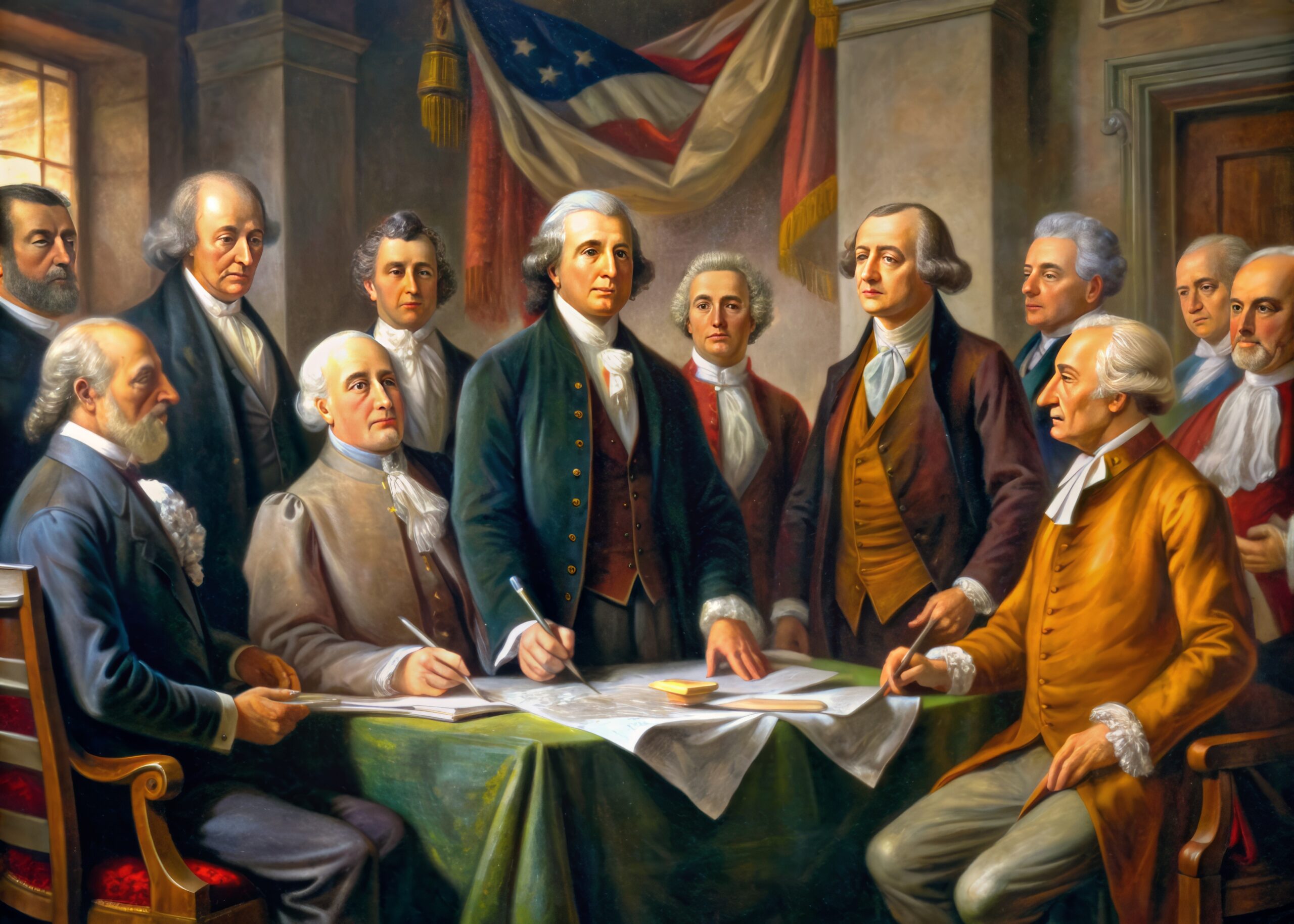
On July 4, 2026, the United States of America marks the 250th anniversary of its founding with celebrations and fanfare in the nation’s capital and throughout the country. The United States was formed on the bold ideals that “all men” hold certain “unalienable rights” to “life, liberty and the pursuit of happiness.” However, how those rights function has evolved significantly in the 250 years since they were first avowed in the Declaration of Independence on July 4, 1776.
From the country’s declaration of sovereignty to today, America’s legal system has developed into a complex structure that frames how the government works, who holds certain rights, and who holds power.
“Certain Inalienable Rights” – The Revolutionary War and Founding of the United States of America
The United States of America was formed on July 4, 1776, when a group called the Second Continental Congress—representing the thirteen original American colonies1—adopted the Declaration of Independence. The Declaration boldly asserts, “We hold these truths to be self-evident, that all men are created equal, that they are endowed by their Creator with certain unalienable Rights, that among these are Life, Liberty and the pursuit of Happiness.” These ideals are the foundation of the American system of law and governance, and they were in direct response to Great Britain’s heavy-handed control of the colonies.
Although the thirteen American colonies declared their independence on July 4, 1776, tensions between Great Britain and the colonies had been simmering for a number of years. From 1763 to 1774, Great Britain had waged a campaign against France and the native people of North America (referred to as the French and Indian War, or the Seven Years War) to acquire more territory in North America. That war was a “success” inasmuch as Great Britain did gain substantial land holdings, but Britain was also left with significant war debt, which it sought to pay by heavily taxing the American colonies. Before the French and Indian War, the colonies largely had enjoyed self-governance without much interference from Great Britain, so the significant new taxes and increased post-war military presence felt stifling to the colonists.
The first shots of the American War of Independence (or the “Revolutionary War”) were fired in April of 1775—more than a year before the Declaration of Independence was signed—when colonial militia members intercepted British troops who were attempting to confiscate weapons and arrest leaders of the rebellion. Years of fighting ensued (during which the Declaration of Independence was signed) and the war eventually concluded with the Treaty of Paris in September of 1783, formally acknowledging the independence of the United States of America.2
“A More Perfect Union” – Adoption of the United States Constitution
While the Revolutionary War waged on, the colonies considered it important to form a new and independent system of government. The Second Continental Congress (the same group that had adopted the Declaration of Independence) adopted “Articles of Confederation” in November of 1777, which were eventually ratified by all thirteen colonies in 1781. The Articles of Confederation established a “league of friendship” among the thirteen colonies-turned-states, with a weak central government that lacked the power to enforce laws, levy taxes, or form a national army.
After the Revolutionary War, many feared that the new country was on the brink of economic disaster, political upheaval, and collapse – due largely to the central government’s lack of power. The Constitutional Convention was convened in 1787 to revise the governmental structure. Ultimately, it was decided to scrap the Articles of Confederation. The new Constitution was signed by the members of the Convention on September 17, 1787, and ratified by the states by 1788. The preamble to the Constitution states its purpose is “to form a more perfect Union, establish Justice, insure domestic Tranquility, provide for the common defence, promote the general Welfare, and secure the Blessings of Liberty to ourselves and our Posterity ….”
Although the Constitution was a significant improvement over the Articles of Confederation, it was nearly defeated by the states because the Constitution lacked certain protections from the type of tyranny Britain had demonstrated toward the colonies. Early leaders advocated for amendments to the newly minted Constitution, which were ultimately adopted in 1789 as the first ten amendments – referred to as the “Bill of Rights.” Those amendments offer protections to American citizens, including freedom of speech and press, freedom to assemble and protest, right to private ownership of weapons, protection from unreasonable search and seizure, protection against the taking of private property without just compensation, protection from self-incrimination, right to due process and trial by jury, and freedom from cruel and unusual punishment.
Seventeen other amendments followed over the next 200 years, for a total of twenty-seven amendments, which govern matters such as election and terms of the president and members of congress, prohibition against slavery, birthright citizenship, the right to vote, and authority to levy income taxes.
“Where There is a Legal Right, There is Also a Legal Remedy” – Judicial Review
The U.S. Constitution established a federal government with three separate branches – Congress, which is the legislative branch; the presidency, known as the executive branch; and the courts, which form the judicial branch. However, the Constitution itself left some important questions unanswered: the exact nature of the Constitution (whether it was a statement of principles and ideals, or actual law) and the relative power of the three branches of government with respect to each other. In 1803 the United States Supreme Court answered those questions in arguably the most significant legal decision in U.S. history, Marbury v. Madison.
Political tensions led up to the Marbury case. John Adams, the outgoing President, had lost the 1800 election to his political foe, Thomas Jefferson. In an effort to retain some power for his political party, Adams appointed several of his supporters as federal judges just two days before the end of his presidential term. However, some of the official commission documents were not delivered before Adams’ presidency ended. Jefferson believed the undelivered commissions were void, so he directed his Secretary of State, James Madison, not to deliver them. William Marbury, one of the judicial appointees, filed a lawsuit asking the U.S. Supreme Court to order that his commission be delivered.
The court found that Madison’s refusal to deliver the commissions was illegal. However, the court also determined that it lacked the jurisdiction to force the commission to be delivered, striking down part of a law Congress had passed (the Judicial Act of 1789) that established the federal court system and defined the courts’ jurisdiction. In doing so, the Supreme Court declared that it had the power to review and invalidate unconstitutional laws. This bold act established the power of courts to examine and invalidate government actions, a concept known as judicial review.
“Life, Liberty, [and] Property” – the Reconstruction Amendments and Civil Rights
Just 85 years after the birth of the new country, it faced its greatest challenge when a Civil War threatened to tear the country in two. Fueled largely by the ongoing dispute over slavery, the War Between the States was fought from 1861 to 1865. Following the end of the war, the country adopted three significant new amendments to the Constitution, commonly called the Reconstruction Amendments because of their role in the post-war rebuilding of the country. The aim of the Reconstruction Amendments was to extend equal civil and legal rights to Black citizens, but they would eventually prove to be even more far-reaching.
The Thirteenth Amendment abolished slavery, a long-overdue acknowledgement of the fundamental rights of life, liberty and the pursuit of happiness for all men, not just white ones. The Fourteenth Amendment enacted several significant principles: (1) the right to citizenship for every person born or naturalized into the United States; (2) the right of every person in the United States to receive due process of law and equal protection of the laws; (3) the number of state representatives based on the whole number of persons (previously, enslaved people had only counted at 3/5); and (4) anyone who has committed insurrection or rebellion against the country, contrary to an oath, not eligible to hold public office. The Fifteenth Amendment prohibits racial discrimination in voting.
These significant amendments fundamentally redefine the relationship between the government and the citizens, acknowledge the basic humanity of all people, and provide protections from government overreach. However, the battle for equal civil rights continues to the present day. It would be fifty more years before the Nineteenth Amendment extended the right to vote to women in 1920 – an act that doubled the American electorate and fundamentally changed American politics; nevertheless, America still has not elected a female president. And although the promise of equal protection to Black citizens gained some initial momentum during and immediately after the post-war Reconstruction Period, many of the initial gains were stifled, perpetuating a system that disenfranchised—and disenfranchises—Black Americans.
From and after the 1950s, there has been renewed vigor in the cause of civil rights. This battle continues to require legislative and judicial intervention to ensure and bolster true equal protection as promised to all citizens of the United States. Specifically, the United States Supreme Court held, in the famous case of Brown v. Board of Education, that it is inherently unconstitutional to segregate people based on race. Later, the United States Congress passed the Civil Rights Act of 1964 and the Voting Rights Act of 1965 to bolster the promises and protections of the Fourteenth Amendment.
The Reconstruction Amendments, most specifically the Fourteenth Amendment, initially were adopted to protect the recently freed former slaves, and those rights continue to serve as a valuable tool in advocating for fair treatment of Black citizens as well as other minority and marginalized people.
“This Land Is Your Land”
As American society has changed, the extent of federal power and individual rights continues to evolve and be refined. The concepts of inalienable rights and equal protection still offer American citizens the promise of fair treatment and opportunity. In the words of American folk singer Woody Guthrie: “This land is your land, this land is my land, … this land was made for you and me.”
Among scholars, there is ongoing debate as to whether the United States Constitution is a “living” document—i.e., subject to revision over time—or should be interpreted strictly and consistently as intended by the drafters when it was written. Regardless, it cannot be denied that the United States Constitution, as amended and interpreted over nearly two and a half centuries, promises the rights to live life free from undue harassment and to pursue economic and social improvement. The American Dream of a country “made for you and me,” though somewhat battered by time, persists 250 years later.
This article does not constitute legal advice but presents only a general overview of common legal principles. Those principles may vary by jurisdiction. You should consult legal counsel with regard to your specific situation. No attorney-client relationship is formed by the publishing of this article.


コメント