
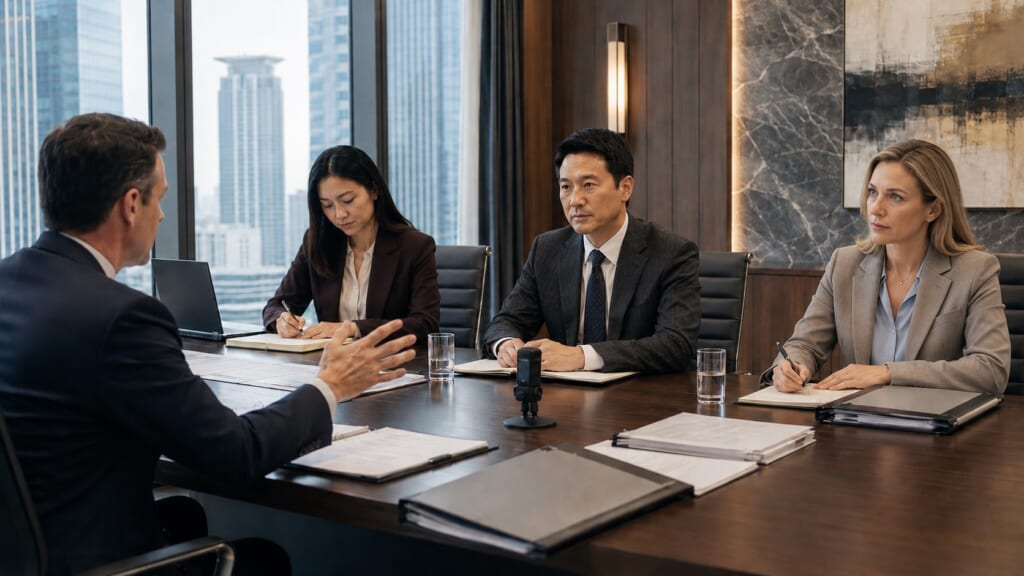
In U.S. civil litigation, an opposing party may take the deposition of a corporation itself. This procedure is governed in federal cases by Rule 30(b)(6) of the Federal Rules of Civil Procedure.
When a company becomes involved in litigation, depositions are not necessarily limited to its president or employees testifying about matters they personally experienced. Under Rule 30(b)(6), the requesting party identifies topics for examination, and the company must designate one or more witnesses to testify on its behalf about those topics. A designated witness must be prepared to testify not only from personal knowledge, but also about information known or reasonably available to the organization.
This obligation can be particularly challenging when information and decision-making authority are divided between a Japanese parent company and its U.S. subsidiary. A witness generally cannot end the inquiry simply by stating, “I was not responsible for this matter at the time,” or “The parent company in Japan made that decision, so I do not know.” The relevant question is whether the organization made a reasonable effort to prepare its designated witness to testify on its behalf.
How a Rule 30(b)(6) Deposition Differs from an Individual Deposition
In an ordinary individual deposition, the requesting party names a particular officer, employee, former employee, or other individual and questions that person about matters within his or her personal knowledge. Under Rule 30(b)(6), the requesting party names a corporation or other organization rather than a particular individual.
The deposition notice must describe the matters for examination with reasonable particularity. The organization then designates one or more officers, directors, managing agents, or other consenting persons to testify on its behalf. A company does not have to assign every topic to one witness. It may, for example, designate an engineering representative for product design, a quality-control representative for safety issues, and an information-technology or legal representative for document-retention matters.
Merely locating the person who appears to know the most and sending that person to the deposition is not enough. The organization must make a reasonable effort to prepare each designee to testify about the matters assigned to that witness. A person who did not work in the relevant department during the period at issue may still serve as a designee after reviewing records, interviewing current and former personnel, and assembling information from across the organization.
Courts have repeatedly explained that this preparation duty extends beyond matters personally known to the designee. It may require review of documents and prior testimony, as well as consultation with current or former personnel and other reasonably available sources. Brazos River Authority v. GE Ionics, Inc., 469 F.3d 416, 432–33 (5th Cir. 2006); United States v. Taylor, 166 F.R.D. 356, 361–62 (M.D.N.C. 1996); QBE Insurance Corp. v. Jorda Enterprises, Inc., 277 F.R.D. 676, 688–90 (S.D. Fla. 2012).
| Individual Deposition | Rule 30(b)(6) Deposition |
| A particular person is named | A corporation or organization is named |
| The witness’s personal knowledge is central | Information known or reasonably available to the organization is central |
| The requesting party selects the witness | The organization generally selects its designee or designees |
| “I do not know” may be a complete answer | Reasonable investigation of other departments and records may be required |
| The witness testifies as an individual | The witness testifies for the organization on the designated matters |
What a Company Should Do After Receiving a Notice
A company receiving a Rule 30(b)(6) notice should not begin by selecting one witness and immediately rehearsing answers. It should first analyze the topics and determine where the relevant information resides within the organization.
1. Examine the Scope of Each Topic
If a topic is vague, duplicative, or excessively broad, counsel should discuss its scope with the requesting party. Following the 2020 amendment, Rule 30(b)(6) expressly requires the serving party and the organization to confer in good faith about the matters for examination. The organization should promptly clarify such issues as the relevant period, products, corporate entities, departments, geographical areas, and categories of information.
2. Check Local Rules, the Assigned Judge’s Practices, and Case-Specific Orders
Rule 30(b)(6) is only the starting point. The local rules of the federal district, the assigned judge’s standing or individual practices, and the scheduling or discovery orders entered in the particular case may impose additional deadlines, numerical limits, procedures, or conference requirements.
The District of Utah provides a useful example. DUCivR 30-2 generally requires a Rule 30(b)(6) notice or subpoena to be served at least 28 days before the deposition and at least 45 days before the discovery cutoff. Unless the court finds good cause or the parties agree otherwise, the notice or subpoena may not exceed 20 topics, including subparts, and the deposition of all representatives may not exceed seven hours in total. The noticed organization generally has seven days to serve written objections, after which unresolved disputes proceed under DUCivR 37-1. These requirements are specific to the District of Utah and should not be assumed to apply in another court.
3. Identify the Sources of Organizational Information
For each topic, the company should identify potentially relevant sources, including:
- Responsible departments and personnel
- Former employees and prior decision-makers
- Email, Microsoft Teams, and other internal communications
- Approval requests, meeting minutes, and authorization records
- Product-design, testing, and quality-control materials
- Customer complaints and incident reports
- Reports exchanged between the Japanese parent and the U.S. subsidiary
- Document-retention policies and litigation-hold notices
- Prior depositions, declarations, interrogatory responses, and court filings
The company should also determine whether the proposed testimony is consistent with its documents, prior submissions, and testimony from other witnesses.
4. Select the Appropriate Designee or Designees
The highest-ranking executive is not necessarily the best witness. The company should select individuals who can understand the assigned topics, review the necessary materials, and communicate accurately in English or through an interpreter.
Assigning numerous topics to one witness may make adequate preparation difficult. Designating too many witnesses, however, can increase cost and create inconsistencies among their testimony. The allocation should reflect both the scope of the notice and the location of the relevant information.
5. Prepare Organizational Testimony
Preparation does not mean teaching a witness to memorize favorable language. A designee should understand the questions and be able to explain accurately, in his or her own words, the facts established by the company’s investigation, the limits of that investigation, the sources consulted, and any necessary qualifications.
If the designee did not personally participate in the events, the witness should be able to distinguish personal knowledge from information learned through corporate records and interviews conducted in preparation for the deposition.
Issues That Commonly Arise for Japanese Companies
Information Is Divided Between the Japanese Parent and U.S. Subsidiary
A U.S. subsidiary may be the entity named in the deposition notice even though product design, quality decisions, budgeting, or final approvals occurred at the Japanese parent. Whether information held by the parent is reasonably available to the subsidiary depends on the corporate relationship and the facts of the case.
It can be dangerous to assume at the outset that no parent-company information needs to be investigated merely because the two companies are separate legal entities. Counsel may need to examine shared officers, ordinary reporting practices, access to records, parent-company approvals, and prior exchanges of information. At the same time, collecting all parent-company information without analyzing relevance and proportionality can unnecessarily expand both the dispute and its cost.
Consensus Decision-Making and Responsibility
Japanese companies may make decisions through internal approval requests, coordination among departments, committee meetings, and approval by senior personnel. A statement that “the company as a whole made the decision” may sound to U.S. counsel or jurors as though the company is concealing who knew what and who was responsible.
The company should be prepared to explain who proposed the action, which departments reviewed it, who possessed approval authority, and what information was available at each stage of the decision.
Japanese Documents and English Translations
An English translation prepared for litigation may not communicate every nuance of the Japanese original. Terms that may appear ordinary in Japanese—such as “consider,” “respond,” “problem,” “malfunction,” or “confirmed safety”—can carry different implications depending on their context.
If a witness prepares only from the English translations, opposing counsel may expose discrepancies with the Japanese originals. For important documents, the company should compare the original text, any translation already produced, and the meaning understood by the witness. Translations of internal terminology, titles, and quality-control terms should be used consistently.
Testimony Through an Interpreter
An executive may be able to conduct routine business in English but still need an interpreter to testify accurately about technical issues, chronology, or internal procedures. The decision should be made with trial counsel after considering accuracy, the language of the principal documents, the witness’s actual proficiency, and the demands of a lengthy adversarial examination.
When an interpreter is used, the witness should listen to the complete question, wait for the interpretation, and then answer. If the interpretation is inaccurate, the witness should address the problem promptly. Long answers increase the risk of omission or distortion, so practicing shorter, clearly organized responses can be helpful.
Investigation Before Saying “I Do Not Know”
A witness should not speculate about matters that remain unknown. Before a Rule 30(b)(6) designee states that the answer is unknown, however, the adequacy of the company’s investigation may be examined.
The company should know whom it consulted, what records it reviewed, and why additional information could not be obtained. There is an important difference between a witness who lacks personal knowledge and an organization that could not confirm the answer after reasonable investigation.
If the organization genuinely lacks the information, cannot reasonably obtain it from other sources, and still lacks sufficient knowledge after reviewing all available information, its preparation obligation may end as to that matter. QBE Insurance, 277 F.R.D. at 690. This limitation does not excuse an incomplete inquiry into accessible records or available witnesses.
Risks of Inadequate Preparation
If a designee is inadequately prepared, the requesting party may seek an additional deposition, recovery of expenses, or court intervention. Depending on the circumstances, attorney fees, evidentiary restrictions, or other discovery sanctions may also become issues. Producing an inadequately prepared designee may even be treated as a practical failure to appear when the organization fails to identify an available, knowledgeable, and readily identifiable witness after reviewing records in its possession. Resolution Trust Corp. v. Southern Union Co., 985 F.2d 196, 197–98 (5th Cir. 1993). This does not mean that every incomplete answer automatically constitutes nonappearance; the organization’s investigation, the availability of better sources, prejudice, and other circumstances matter.
Rule 30(b)(6) testimony may be used against the organization at summary judgment or trial. In the Tenth Circuit, which includes Utah, such testimony is treated as an evidentiary admission rather than an irrevocable judicial admission. It may be corrected, explained, or supplemented, but an unexplained material inconsistency may be used for impeachment or may affect whether later evidence will be considered. Vehicle Market Research, Inc. v. Mitchell International, Inc., 839 F.3d 1251, 1260–61 (10th Cir. 2016). A company that later offers a materially different account or new evidence may therefore be asked why its designee did not know the information and why it was not discovered before the deposition.
Inadequate preparation can also damage the company’s credibility. If the corporate representative cannot explain product safety, incident response, or document preservation, the opposing party may argue that the company does not understand—or did not adequately manage—its own operations.
What Effective Witness Preparation Should Include
Effective preparation requires more than practicing expected questions and answers. It may include:
- Mapping the sources of information and scope of testimony for each topic
- Recording the materials reviewed and personnel consulted by each designee
- Preparing a chronology and decision-making map
- Comparing Japanese originals with translations already produced
- Checking consistency with prior testimony, pleadings, and interrogatory responses
- Distinguishing personal knowledge from organizational knowledge acquired during preparation
- Establishing a process for additional investigation when gaps are identified
- Conducting a mock deposition with the interpreter, if one will be used
- Avoiding speculation, unnecessarily long answers, and unsupported absolute statements
- Preparing trial counsel to address questions that may exceed the designated topics
Counsel should never teach a witness to give false answers or adopt a version of events merely because it favors the company. The purpose is to enable the designee to explain, accurately and consistently, the facts established through the organization’s reasonable investigation.
Checklist for Management and Legal Departments
After receiving a Rule 30(b)(6) notice, a Japanese company should promptly consider at least the following questions:
- Have the response deadlines and proposed deposition date been identified?
- Has the complete notice been sent immediately to U.S. trial counsel?
- Have the relevant period, products, entities, and departments been identified for each topic?
- Has counsel begun discussing vague or excessively broad topics with the requesting party?
- Have the local rules, the assigned judge’s practices, and case-specific orders been checked?
- Has the need to obtain information from the Japanese parent been evaluated?
- Are the relevant materials subject to an effective litigation hold?
- Have current and former personnel, information custodians, and decision-makers been identified?
- Has the company considered whether to divide the topics among multiple designees?
- Have important Japanese documents been compared with their English translations?
- Has the need for an interpreter been evaluated early?
- Has the company checked for inconsistencies with prior statements and filings?
- Is there enough time for supplemental investigation and a mock deposition?
Conclusion
Rule 30(b)(6) does not merely require a company to produce the individual who appears to know the most. It requires the organization to investigate the designated matters, select appropriate witnesses, and prepare them to testify on its behalf.
When a Japanese company becomes involved in U.S. litigation, that process may require coordination across the Japanese parent, U.S. subsidiary, multiple departments, former and current personnel, Japanese-language records, and interpreters. If the company delays its initial response, it may not have enough time to collect the information and prepare its designees adequately.
Management and legal personnel should confer with U.S. trial counsel promptly to define the topics, information sources, witnesses, and working language. Adequate preparation is important not only to satisfy discovery obligations, but also to ensure that the company’s explanation is communicated accurately to the court, opposing counsel, and, ultimately, the jury.
This article is intended for general informational purposes and does not constitute legal advice concerning any particular matter. The application of Rule 30(b)(6), the appropriate scope of investigation, witness designation, available objections, and procedural requirements may vary based on the facts, controlling law, local rules, the assigned judge’s practices, scheduling and discovery orders, and other case-specific directives. Companies should consult counsel responsible for the specific litigation.
Principal Authorities
- Federal Rule of Civil Procedure 30(b)(6), Depositions by Oral Examination
- 2020 Advisory Committee Note to Rule 30(b)(6)
- DUCivR 30-2, Notice or Subpoena Required for Depositions Under Fed. R. Civ. P. 30(b)(6)
- Brazos River Authority v. GE Ionics, Inc., 469 F.3d 416, 432–33 (5th Cir. 2006)
- QBE Insurance Corp. v. Jorda Enterprises, Inc., 277 F.R.D. 676, 688–90 (S.D. Fla. 2012)
- Resolution Trust Corp. v. Southern Union Co., 985 F.2d 196, 197–98 (5th Cir. 1993)
- United States v. Taylor, 166 F.R.D. 356, 361–63 (M.D.N.C. 1996)
- Vehicle Market Research, Inc. v. Mitchell International, Inc., 839 F.3d 1251, 1260–61 (10th Cir. 2016)
コメント