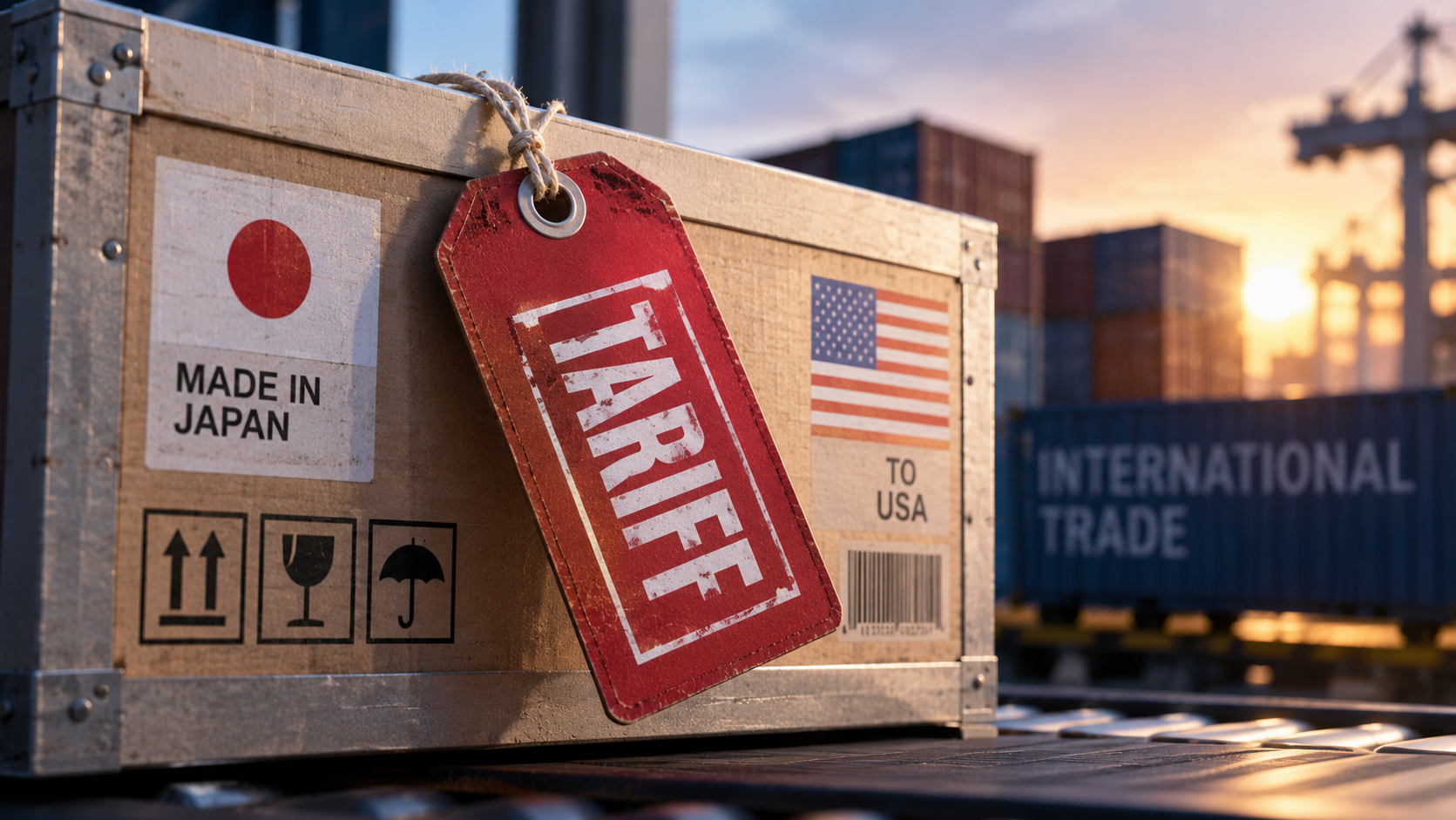
Note: This article was written based on the 2025 tariff agreement between the United States and Japan.
Introduction
President Trump’s second term has brought significant discussion about the policies he intends to implement to achieve his stated goals on behalf of the United States. Some actions related to international relations and trade have caused an uproar of diverse, sometimes heated, opinions among world leaders.1 While some leaders are upset, as negotiations have progressed, many deals have been made, including a deal with the subject of this article, Japan.2
This article focuses on the United States’ reciprocal tariff deal with Japan and its potential impact on each country’s citizens and businesses. Below is a discussion related to what tariffs are, why they are being implemented, current trade policies between the United States and Japan, and who may be impacted by this deal between the United States and Japan.
What is a tariff?
Before discussing these tariffs, it is critical to understand what a tariff is and why a country’s leader may implement tariffs. Tariffs are a form of tax that the federal government places on imported goods and services.3 When goods or services are brought to the US from another country, the tariff is like a sales tax, generating government revenue. President Trump’s tariffs have been in the news since President Trump’s campaign, with widespread speculation and some trepidation about how they may affect a country’s citizens and trade partners. Companies that manufacture their goods in foreign countries have been worried that these tariffs will make their goods too expensive to produce and that cost would then be passed down to the consumer.4
It would appear that President Trump’s tariffs are generally intended to be reciprocal. A reciprocal tariff “is a tax or trade restriction that one country places on another in response to similar actions taken by that country.”5 “The idea behind reciprocal tariffs is to create balance in trade between nations.”6 “If one country raises tariffs on goods from another, the affected country might respond by imposing its own tariffs on imports from the first country.”7 “This response is meant to protect local businesses, preserve jobs, and fix trade imbalances.”8
It’s easy to see how reciprocal tariffs could lead to large swings in trade costs between countries. If one country decides to raise its tariff rate and the United States responds in like manner, the ones who suffer are most likely the citizens of the two countries who are the end consumers of the imported or exported goods. These trade disputes can disrupt supply chains, raise prices for both economies, and generally slow economic growth.9
Why is President Trump implementing tariffs?
With all the discussion on tariffs and their uncertainty, why is President Trump implementing so many tariffs?
The answer is ostensibly to reduce the trade deficit with other countries. A trade deficit is defined as a country’s total exports minus its total imports. For example, the U.S. imports significantly more from Japan than it exports to Japan. Because of this, the United States is currently experiencing a trade deficit with Japan, and President Trump states that he hopes to decrease the deficit with these tariffs.10
Moreover, President Trump has stated that he believes these trade deficits and lack of reciprocity are national emergencies. He said, in an executive order dated September 4, 2025:
“I, DONALD J. TRUMP, President of the United States of America, find that underlying conditions, including a lack of reciprocity in our bilateral trade relationships, disparate tariff rates and non-tariff barriers, and U.S. trading partners’ economic policies that suppress domestic wages and consumption, as indicated by large and persistent annual U.S. goods trade deficits, constitute an unusual and extraordinary threat to the national security and economy of the United States. That threat has its source in whole or substantial part outside the United States in the domestic economic policies of key trading partners and structural imbalances in the global trading system. I hereby declare a national emergency with respect to this threat.”11
In line with his statement regarding a national emergency, President Trump said he believes a “nation’s ability to produce domestically is the bedrock of its national and economic security.”12 He continued by saying that “increasing domestic manufacturing is critical to U.S. national security.”13
Another reason President Trump stated that he was implementing these tariffs was to bring new revenue to the United States and that “[t]axpayers have been ripped off for more than 50 years,” “But it is not going to happen anymore.”14 President Trump’s position to the world seems to be that these tariffs will generate extra revenue for the country without increasing income tax rates. It is too early to determine what benefits, if any, these tariffs will bring to the U.S. Will these tariffs be a detriment to the United States’ international relations, or will they generate prosperity for the United States and Japan? Time will tell.
What are the current trade policies between Japan and the U.S. under this tariff?
While President Trump has implemented sweeping tariffs globally, this article focuses on specific policies and tariffs between the United States and Japan. As of July 2025, the U.S. and Japan reached a preliminary agreement on tariffs and trade policies.15 The prominent features of this agreement are a 15% reciprocal tariff and a $550 billion Japanese/U.S. investment.16
Japan’s deal with the United States includes a 15% reciprocal tariff on nearly all Japanese imports entering the United States, alongside sector-specific treatment for automobiles and automobile parts; aerospace products; generic pharmaceuticals; and natural resources that are not naturally available or produced in the United States.17
The $550 billion investment from Japan will be invested in multiple specific industrial sectors in the United States. More particularly, the money will be invested at President Trump’s direction and targeted toward revitalizing America’s strategic industrial base. The specific sectors President Trump says he intends to bolster through this investment are energy infrastructure and production; semiconductor manufacturing and research; critical minerals mining, processing, and refining; pharmaceutical and medical production; and commercial and defense shipbuilding.
The White House’s fact sheet indicated that the United States would retain 90% of the profits from this investment.18 The President says he intends to ensure that American workers, taxpayers, and communities reap the overwhelming share of the benefit.19 The President has stated he believes this will be a “once-in-a-century industrial revival.”20
Who is affected by tariffs?
Ultimately, no tariff matters if it doesn’t impact the lives of each country’s citizens. It is not clear exactly who may be affected by these tariffs. However, one can speculate about the sectors and people any tariff may impact.
First, the most obvious answer regarding the parties impacted by the Japan/United States deal is each country’s citizens. If tariffs raise the prices of importing and exporting everyday goods and services to the other country, the increased prices will flow down to the end customer, the citizens. If the price to produce or provide a product or service increases, the end price will likely increase.
Other than the citizens of each country, several sectors will likely be impacted, including agriculture and food, energy, manufacturing and aerospace, and automobiles and industrial goods.21
In the agriculture and Food sector, Japan will increase its imports of U.S. rice by 75% and purchase $8 billion in U.S. goods, including corn, soybeans, fertilizer, bioethanol, and sustainable aviation fuel.22
In the energy sector, the two countries are exploring a new offtake agreement for Alaskan liquefied natural gas.23
In the manufacturing and aerospace sectors, Japan has committed to purchasing 100 Boeing aircraft. It has also committed to purchasing additional billions of dollars of U.S. defense equipment annually, enhancing interoperability and alliance security in the Indo-Pacific.24
In the automobiles and industrial goods sector, restrictions on United States cars and trucks will be lifted, granting United States automakers access to the Japanese consumer market. Further, United States automotive standards will be approved in Japan for the first time.25
Finally, there will be broader openings for industrial and consumer goods, which President Trump says he believes will level the playing field for American producers.26
Conclusion
In conclusion, it is hard to tell how things will ultimately pan out. Hopefully, the two countries can continue to economically coexist, and these deals can benefit not only one country or the other but also each individual United States or Japanese citizen. Time will tell the effectiveness of these tariffs, but their long-term impact will likely depend on a delicate balance of economic forces and international diplomacy.
If companies are willing to absorb the increased costs associated with tariffs, their profit margins may shrink, slowing their growth. Instead, if those costs are passed down to consumers in both nations, citizens will almost certainly face higher prices for everything they use daily. Price increases could contribute to increased inflation, which may offset some of the economic gains President Trump hopes to achieve through increased revenue and domestic production.
At the same time, if the tariffs succeed in reducing trade deficits, shoring up key industries, and strengthening domestic manufacturing, this could be a pivotal moment in reshaping America’s economy. As for Japan, the success of these tariffs could mean deeper economic integration with the United States, which could open new markets and create opportunities in previously untapped sectors.
Ultimately, tariffs are more than just taxes on trade; what we have seen is that President Trump is attempting to use them as tools of economic strategy. The consequences of these tariffs, for better or for worse, will ripple far and wide into the lives of each country’s citizens. Whether these consequences strengthen each nation or burden its citizens is a question that may take years or even decades to answer. Only time will tell.

コメント